

Organic Chemistry Tutoring Resources
“He is a very hands on tutor that helps you stay on track with learning material. He also provides tailored worksheets for your week areas and walks you through them. He’s available anytime if you have to text him questions which I found valuable to deal with midterms. ”
ON-DEMAND VIDEO LIBRARY AND Q-BANK
SIGN UP for an Ochem Membership
By signing up for a membership you will receive special access to many of our products. Whats included in your membership?
100+ Tutoring Videos
Question Bank
Worksheets
Lecture Notes
Practice Quizzes
Practice Exams
Exams
IR Spectroscopy/H-NMR
Ochem Quarters 1-3
Orgo 1-2
All-Inclusive Organic Chemistry Experience
Organic Chemistry Tutoring
Access to Ochem Specialist
Get anytime access to our growing collection of classes, workshops, and exclusive content. New items added every month.
Get anytime access to our growing collection of classes, workshops, and exclusive content. New items may be added every month.
Get a sneak peek of our on-demand video library….
Subscribe monthly or every 3 months to receive exclusive access to 100 tutoring videos each one hour in length. Students can view Ochem content at their own pace, any time, and any place.
SHOP NOW - Tutoring Videos
Our tutoring videos are split into collections or a bundle package. You can purchase video bundles by individual quarter or as a package which includes 100+ videos covering topics that are learned in General Organic Chemistry courses. Want our videos and more? Sign up for the membership instead where you will receive access to these videos and more! Updated videos are posted to our members exclusive areas frequently. See our sample below.
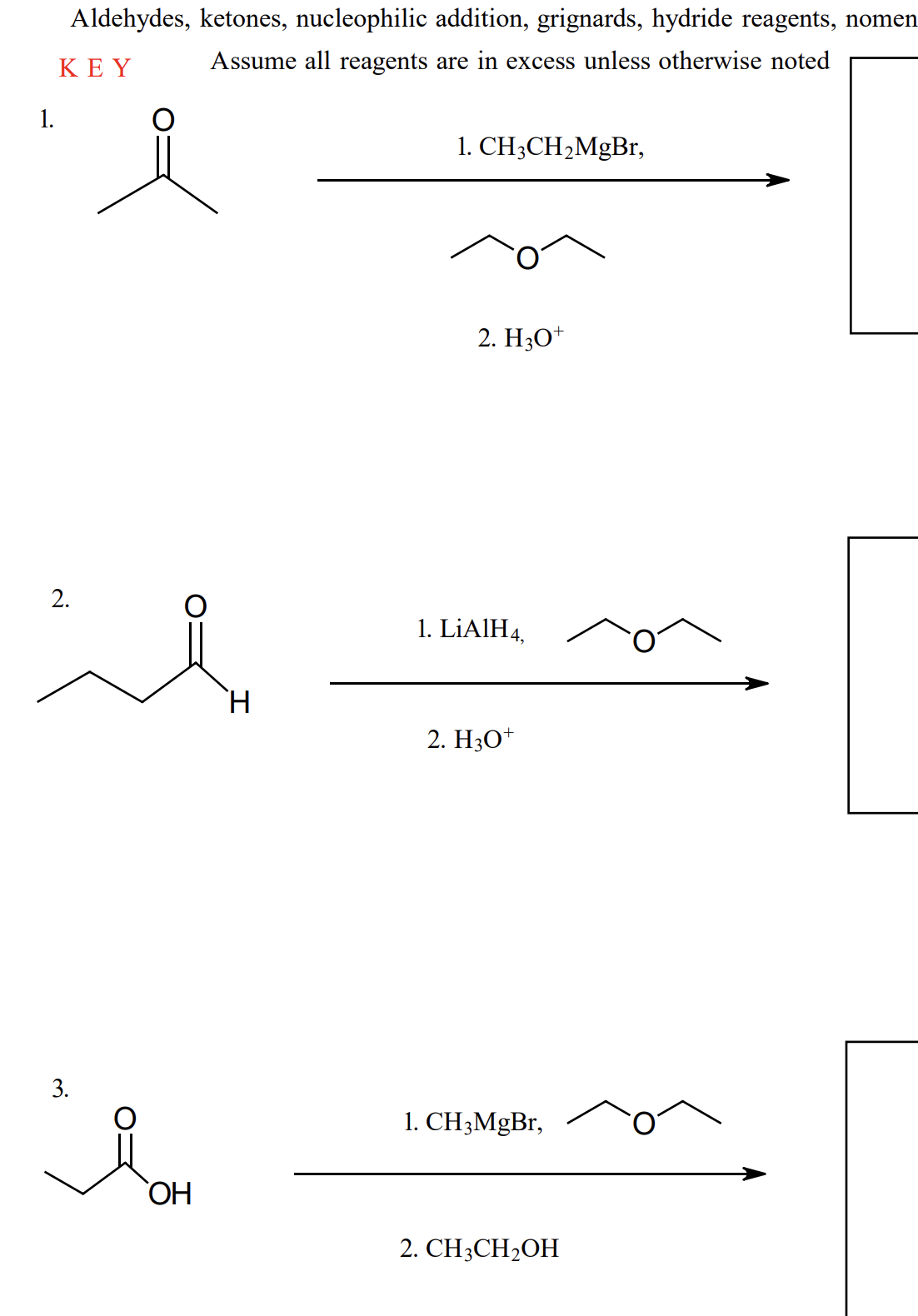
Worksheet for "Aldehydes, Ketones, Grignard Reactions, LiAlH4, and Nomenclature Key" with detailed explanations and examples covering the following topics:
Nomenclature:
Naming conventions for aldehydes and ketones based on IUPAC rules.
Common names and their systematic equivalents.
Structural characteristics distinguishing aldehydes from ketones.
Structure and Properties:
Structural features of aldehydes and ketones.
Physical properties (boiling points, solubility, etc.) and how they relate to molecular structure.
Preparation of Aldehydes and Ketones:
Oxidation of primary alcohols to aldehydes.
Oxidation of secondary alcohols to ketones.
Special methods for preparing specific aldehydes and ketones
Reactions of Aldehydes and Ketones:
Nucleophilic Addition Reactions: Mechanisms and examples (e.g., hydration, cyanohydrin formation).
Oxidation and Reduction Reactions: Differentiating between aldehyde and ketone reactions.
Condensation Reactions: Formation of acetals, imines, and enamines.
Grignard Reagents:
Preparation and structure of Grignard reagents (RMgX).
Addition reactions with aldehydes and ketones to form alcohols (Grignard addition).
Mechanism of Grignard reagent reactions with carbonyl compounds.
Reduction with LiAlH4:
Preparation and handling of LiAlH4.
Reduction reactions with aldehydes and ketones to form primary and secondary alcohols.
Mechanism of LiAlH4 reduction reactions.
The "Lewis Acids and Bases and Naming Worksheet" includes exercises that help students understand the concepts of Lewis acids and bases and how to name chemical compounds. Here is a brief description based on the content:
Lewis Acids and Bases:
Definition and Identification: Exercises include identifying Lewis acids and bases from given chemical reactions. A Lewis acid is an electron pair acceptor, while a Lewis base is an electron pair donor
Examples and Practice: The worksheet provides various chemical equations where students need to label the Lewis acids and bases, promoting a better understanding of electron pair interactions.
Naming Compounds:
Ionic and Covalent Compounds: Instructions and practice problems for naming ionic compounds (both binary and those with polyatomic ions) and covalent compounds, emphasizing the use of prefixes and the rules of nomenclature.
Transition Metals: Exercises on naming compounds with transition metals, requiring students to use Roman numerals to indicate the oxidation state of the metal.
Acids and Bases: Sections focused on naming acids (binary acids and oxyacids) and bases, highlighting the conventions used for each type.

This PDF downloadable worksheet explores drawing structures, hybridization, condensed formulas, kekule structures, resonance, acids and bases, lewis acids and bases, formal charge and more. This question set contains about thirty practice questions with the answers provided.

This PDF downloadable worksheet explores the differences between SN2, SN1, E2, and E1 reactions. Reagents include: NaNH2, NaSH, NaI, NaN3, CH3OH, NaCN, NH3, H2SO4, H2O, KF, KOH, Cl2, CH3CH2OH, and more. This question set contains twenty-nine practice questions with the answers provided.

This PDF downloadable worksheet explores reactions using F2, Cl2, Br2, and I2. These chemical reactions are mixed with hv or heat to conduct the reaction. Outline the differences between initiation, propagation, and termination. Name compounds, including alkanes and cycloalkanes. Draw chairs, chair conformers, and indicate which is most stable vs least stable. Compare and contrast equatorial vs axial groups. This question set contains about thirteen practice questions with the answers provided.
This PDF downloadable worksheet accomplishes the following lecture objectives:
1. Recognize when conjugation applies, how it impacts chemical stability, and use it to predict and rank stabilities of various substances
2. Predict and rank how various reactions and their reaction rates are impacted by conjugation/resonance, whether in a reactant or an intermediate or a product, for example in SN1 reactions, radical reactions, or acid-base reactions
3. Predict the products of hydrogen halide additions to conjugated dienes.
4. Identify 1,2 vs 1,4 addition products in hydrogen halide additions to conjugated dienes
5. Identify thermodynamic versus kinetic products
6. Predict the products of allylic radical bromination reactions.
7. Draw mechanisms for addition reactions or SN1 reactions proceeding through allylic cations
8. Draw resonance structures for allylic cations, radicals, or anions
This question set contains twelve practice questions with the answers provided.
This PDF downloadable worksheet explores assigning R/S configurations using the Cahn Ingold Prelog system. Assign RS to various organic structures. Draw all enantiomers and diastereomers as Fischer projections. Indicate whether structures are identical, structural isomers, conformers, or stereoisomers. Differentiate identical structures from enantiomers. Describe which of the following molecules are chiral vs achiral. Identify meso compounds. This question set contains thirty five practice questions with the answers provided.

This PDF downloadable practice exam covers nomenclature, ranking acidity based on pKa, bond-line formulas, condensed formulas, HNMR, hybridization, stereocenters, chirality, enantiomers, diastereomers, constitutional isomers, isomers, stereoisomers, meso, identical, chairs, chair stability, Newman projections, predict the product, tert-butoxide, PI3, Cl2, PCC, Grignard, H2O, H2SO4, Mechanism of H2SO4 with alcohol, SYNTHESIS problem, and spectroscopy (IR, HNMR).This practice exam contains forty-three practice questions with the answers provided.
SHOP NOW - Worksheets
This PDF downloadable worksheet explores drawing structures, hybridization, condensed formulas, kekule structures, resonance, acids and bases, lewis acids and bases, formal charge and more. This question set contains about thirty practice questions with the answers provided.
This PDF downloadable worksheet explores naming structures, naming alkanes, drawing energy diagrams, conformers, ranking based on boiling point, Newman projections and more. This question set contains about thirteen practice questions with the answers provided.
This PDF downloadable worksheet explores reactions using F2, Cl2, Br2, and I2. These chemical reactions are mixed with hv or heat to conduct the reaction. Outline the differences between initiation, propagation, and termination. Name compounds, including alkanes and cycloalkanes. Draw chairs, chair conformers, and indicate which is most stable vs least stable. Compare and contrast equatorial vs axial groups. This question set contains about thirteen practice questions with the answers provided.
This PDF downloadable worksheet explores assigning R/S configurations using the Cahn Ingold Prelog system. Assign RS to various organic structures. Draw all enantiomers and diastereomers as Fischer projections. Indicate whether structures are identical, structural isomers, conformers, or stereoisomers. Differentiate identical structures from enantiomers. Describe which of the following molecules are chiral vs achiral. Identify meso compounds. This question set contains thirty five practice questions with the answers provided.

This PDF downloadable worksheet explores the essentials of SN2 vs SN1 reactions. Differentiate SN2 from SN1 nucleophiles and reagents. Predict the product for various reactions. Utilize reagents such as NaOH, H2O, NaN3, CH3OH, NaI, NaNH2, KF, H2SO4, NH3, HCl, KOH, Cl2, CsI, NaCN, and much more. This question set contains twenty-eight practice questions with the answers provided.
This PDF downloadable worksheet explores the differences between SN2, SN1, E2, and E1 reactions. Reagents include: NaNH2, NaSH, NaI, NaN3, CH3OH, NaCN, NH3, H2SO4, H2O, KF, KOH, Cl2, CH3CH2OH, and more. This question set contains twenty-nine practice questions with the answers provided.

This PDF downloadable worksheet explores the differences between SN2, SN1, E2, and E1 reactions. Reagents include: NaNH2, tert-butoxide, NaOCH3, NaSCH3, KCN, NaSH, NaI, NaN3, CH3OH, NaCN, NH3, H2SO4, H2O, KF, KOH, Cl2, CH3CH2OH, and more. This question set contains thirty-four practice questions with the answers provided.

This PDF downloadable worksheet explores alcohols. Name the following alcohols. Rank the compounds in order of decreasing acidity. Predict the product for various reactions including alcohols and HI, alcohols and HS2O4, alcohols and SOCl2, and much more. Practice SYNTHESIS questions. Prepare oxidation and reduction reactions using Jones, PCC, CRO3, Grignard, RLi, Organolithium, and more. This question set contains twenty-eight practice questions with the answers provided.

This PDF downloadable worksheet explores alkenes. Predict the products and describe the major organic material based on a reaction. Utilize reagents such as NaOCH2CH3, t-BuOK, tert-butoxide, H2SO4, dehydration of alcohols, ozonolysis, O3, Cl2, HBr in ROOR, and NaSC2H5. Practice naming alcohols and alkenes, conduct SYNTHESIS reactions. Predict the reagents given starting and final material. Large emphasis on alkene formation and E2 reactions. Reactions of alkenes also high yield for this worksheet. This question set contains eight practice questions with the answers provided.

This PDF downloadable worksheet explores alkynes. We focus on reactions of alkynes in this worksheet. The reactions include halogenation of alkynes, ant-mark vs markovnikov addition of H2O or Br across a triple bond. We also focus on BH3, THF, H2O2, H2O, NaOH. MCPBA and PCC will also be explored in a SYNTHESIS reaction. Lastly, there is one spectroscopy question. This question set contains thirteen five questions with the answers provided.
This PDF downloadable worksheet accomplishes the following lecture objectives:
1. Recognize when conjugation applies, how it impacts chemical stability, and use it to predict and rank stabilities of various substances
2. Predict and rank how various reactions and their reaction rates are impacted by conjugation/resonance, whether in a reactant or an intermediate or a product, for example in SN1 reactions, radical reactions, or acid-base reactions
3. Predict the products of hydrogen halide additions to conjugated dienes.
4. Identify 1,2 vs 1,4 addition products in hydrogen halide additions to conjugated dienes
5. Identify thermodynamic versus kinetic products
6. Predict the products of allylic radical bromination reactions.
7. Draw mechanisms for addition reactions or SN1 reactions proceeding through allylic cations
8. Draw resonance structures for allylic cations, radicals, or anions
This question set contains twelve practice questions with the answers provided.